The Canary Box

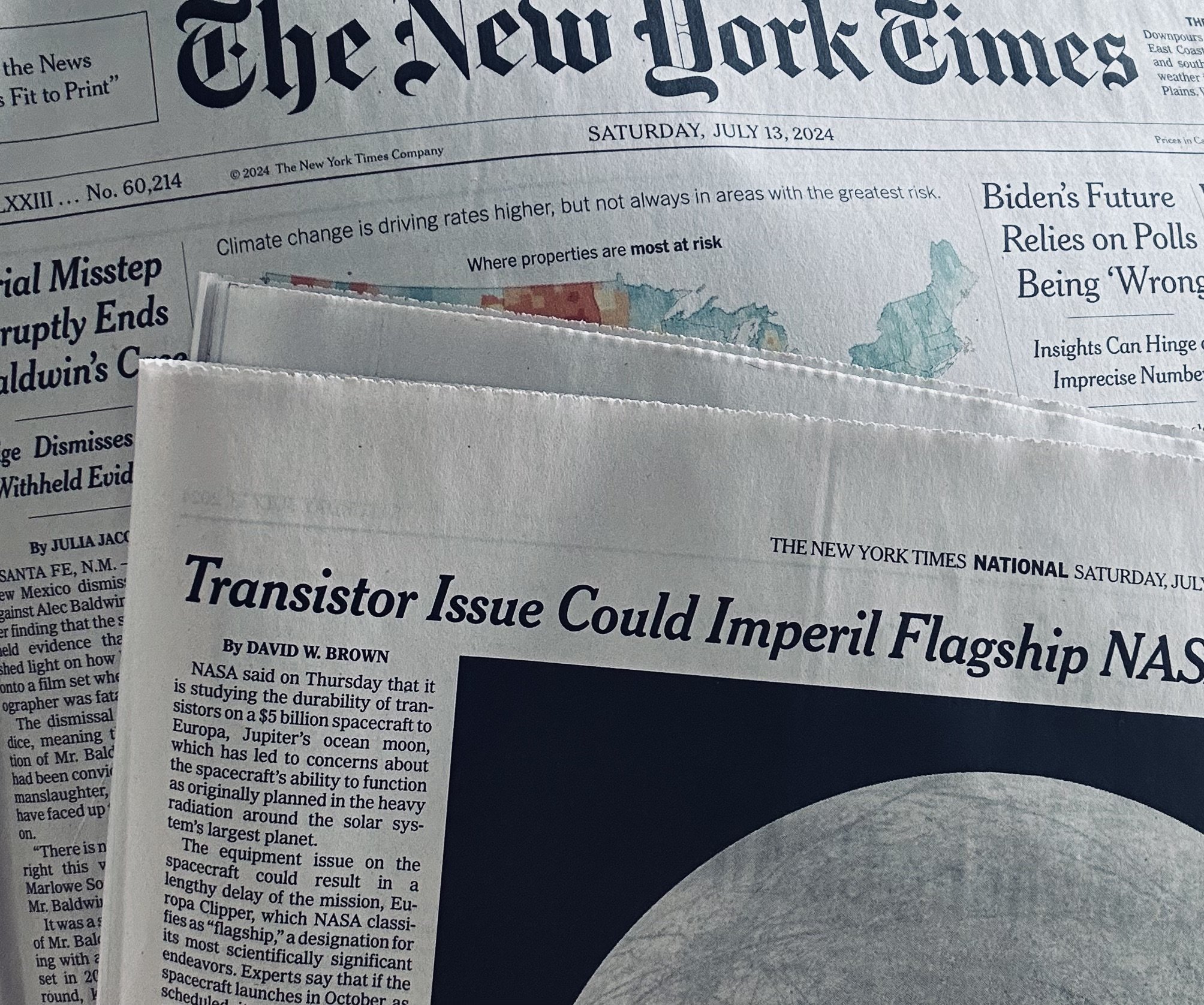
For The New York Times, I tell the inside story of the desperate race to save NASA’s flagship mission to Jupiter’s ocean moon. A snippet:

People at NASA headquarters take deep breaths when the words “First Story” appear in their email. Late this spring, Curt Niebur, the lead scientist for flight programs, received such a message.

“You open that email right away,” Dr. Niebur said. “You read it, and then you reply, ‘Thank you for sharing,’ and then you bury your face in a pillow and you howl in terror.”

The matter prompting Dr. Niebur’s apprehension involved Europa Clipper, one of NASA’s most scientifically important missions. The agency’s science division created the “First Story” process to encourage science project staff members to communicate potentially bad news without fear of overreaction by leadership.

This news seemed exceptionally bad. If what Dr. Niebur was reading was true, Europa Clipper was cooked.

NASA had spent more than $5 billion on the planetary probe. It is the largest ever built — as big as a basketball court with its solar arrays extended. The mission’s job is to help scientists on Earth determine the potential habitability of Europa, the moon of Jupiter that is wrapped in a thick shell of ice, beneath which a warm ocean flows with twice as much saltwater as on Earth. Scientists believe it has all the chemical ingredients for alien life to have emerged.

In late May, Europa Clipper was set to be shipped to Florida to prepare for its October flight opportunity. If it missed its launch window, scientists would face a long wait for another shot — if the problem could even be solved.

Across NASA and its affiliate research labs, teams would soon find their summer dominated by a terrifying question: Was Europa Clipper doomed?

Read the rest here. (It will be on newsstands next Tuesday.)

Update: It is today’s “Great Read” —what an honor!
If Beijing Is Worried about Its Air Quality, Worry.

The front page of the New York Times today features an astonishing story about Beijing that begins: "Residents across this city awoke to an environmental state of emergency on Tuesday as poisonous air quality prompted the government to close schools, force motorists off the road and shut down factories." Abstractly, it is the kind of story you read, consider for a moment, and go about your day. "Smog," you think. "Just awful." Had I not visited Beijing last year, I'd have thought the same thing, and immediately forgotten about the problem. But having been there, I'm thunderstruck by how horrible things must actually be this week for the government to admit there's a problem, let alone close the city down.

Beijing is the kind of city where you're never more than ten minutes from a marvel of human history. The Forbidden City, the Temple of Heaven, Lama Temple, the Summer Palace—they all just seem so impossible, so immense, so stunning to behind and impossible, really, to comprehend. The city's parks are splendid, and the food and the vibe and the people—it's a terrible place to have to leave.

But the air pollution is scary. Not the way weepy environmentalists find everything not made of hemp to be scary, but scary in a humanity-cannot-survive-this sort of way. If you don't believe humans can be the cause of climate change, visit Beijing.

Nobody warned me about China's pollution problem in advance, and I'm not the sort of person who notices that kind of thing. When I close my eyes and visualize the word "pollution," I see a toxic waste dump (or what I imagine a toxic waste dump to look like), with barrels floating on a lake of sludge. Anything short of that tends to escape my attention. So upon arrival, I thought, "Wow, foggy day."

Within two days, my eyes were burning. It wasn't like seasonal allergies, where your brain acknowledges the discomfort, you complain a bit, and then go about your business. This was alarming on a visceral level. My eyes were burning simply because I was using them. And that deep part of your brain that knows when something is definitely Not Right was at red alert. Whatever was burning my eyes wasn't natural—wood on fire, say—but artificial and chemical, something that human beings did not evolve to handle.

It didn't ruin my trip, and I don't want to sound (too) apocalyptic about all of this, but it did give me a new appreciation for the urgency of addressing human environmental impact. At the top of this post is a photograph I took of the city that is representative of every photograph I took there. This is what Beijing looks like on a clear, sunny day, when nobody is particularly worried and the city government wants everyone to go about their business. I can only scarcely imagine how much worse things must be for them to panic.


When Congress Puts NASA on Hold, Planets Don’t Wait

Today's edition of the New York Times contains my very first op-ed for them, on how budgetary uncertainties harm the American space program.

The United States asks NASA to do an extraordinary amount with very little money. Explore Mars, document climate change, stop doomsday asteroids, find life on Europa — all for less than one-half of 1 percent of the federal budget. But budget uncertainties on Capitol Hill, including delays in federal appropriations legislation and temporary government shutdowns, measurably harm the American space program. Even the threat of a shutdown can have a far-reaching impact on scientific projects, often in unexpected ways.

Read the rest here. (Or go buy a copy.)

Thank you to Casey Dreier at the Planetary Society, who is infinitely patient and kind, and one of the smartest guys in the business.

UPDATE: Hello New York Times readers! You might also be interested in this piece I wrote for Vox earlier this year on the looming gap in outer planetary exploration.