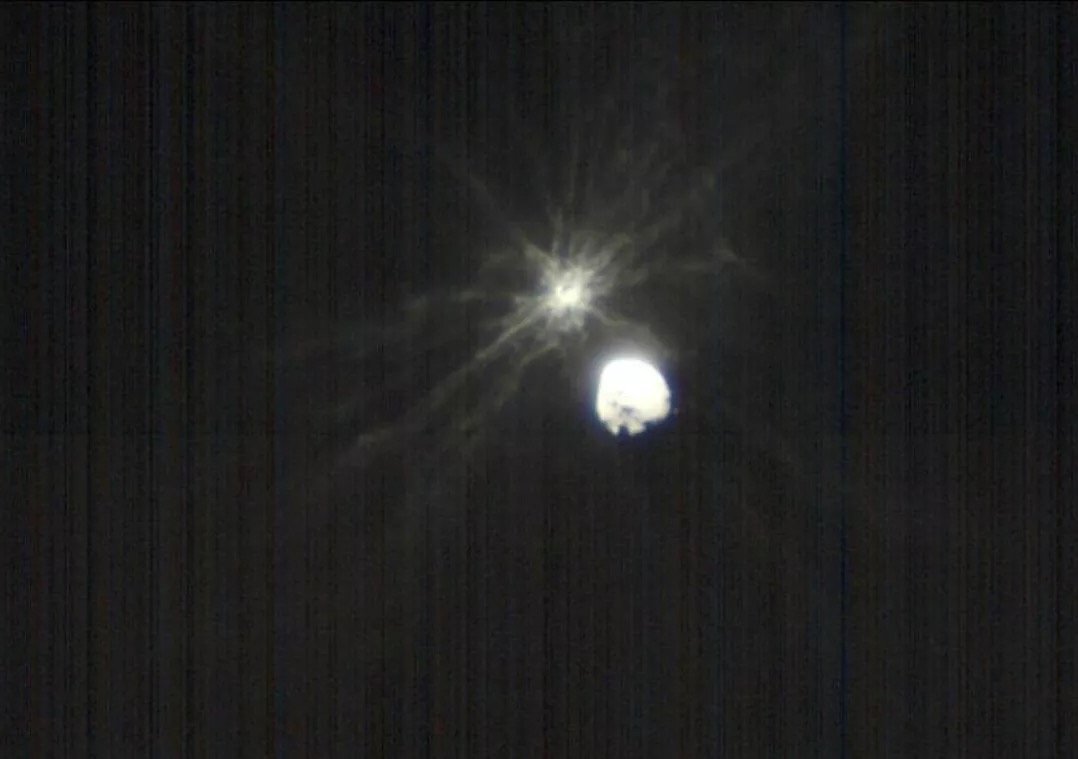
Over the Moon

[NOTE: Rather than posting haphazardly to this blog, my current plan is to publish haphazardly to my Substack. You should definitely subscribe.]

For most of this year, while finishing The Outside Cats, I basically stopped doing freelance writing. I started up again last month, with a short piece on NASA’s nuclear and Mars ambitions, for Scientific American. (The answer to the headline is “no,” though I had a hard time finding anyone who would say that on the record.)

Then, for The New Yorker, I’ve written two pieces on the return of humans to the moon. The first was something of an elegy for the space program. The NASA that went back to the moon looks a lot like the NASA that went there fifty years ago. But going forward, space exploration will look very different—and that’s not a good thing. A snippet:

Beginning with Artemis III, in the name of efficiency, NASA will start handing major elements of the lunar program over to private companies, including SpaceX and Blue Origin. NASA will neither build nor own the next generation of lunar landers. It will basically hire a rideshare service to bring its astronauts from lunar orbit to the surface, and it will even rent its spacesuits from a contractor called Axiom Space. In the Trump Administration’s budget for the fiscal year 2026, it sought to cancel the Artemis rocket, known as the Space Launch System, in favor of commercial alternatives still in development, such as SpaceX’s Starship. The NASA of old was spread across the country so that many communities would benefit from its investments; the new space program will be increasingly privatized and concentrated in Texas and Florida. One wonders if it can live up to NASA’s longstanding motto: “For the benefit of all.”

Read the rest here.

Then, for “The New Yorker Interview,” I visited Johnson Space Center in Houston and met with astronaut Reid Wiseman, who commanded Artemis II. For a guy who just got back from the moon, he was surprisingly modest, and wasn’t afraid to be vulnerable. A snippet from our conversation:

How has your experience changed your perceptions of the Apollo astronauts and what they did?

I really felt disbelief that Apollo 8 had the courage to leave low-Earth orbit for the first time. They went all the way to the moon in that Apollo spacecraft. I just thought about them. I’m, like, I wonder if they were a little bit scared, because I’m a little bit scared. I bet they were a little bit scared. They’d never admit it. I won’t admit it—although I just did—but I bet they were a little bit scared. That was a crazy thing that they did.

For a lot of reasons, those interviews are a lot more difficult to write than essays (and unbelievably complicated to condense), and I am very proud of how it turned out. You can read the rest here.

UPDATE: The interview was featured on the New Yorker Radio Hour podcast, with David Remnick, and broadcast on WNYC. This is pretty cool!

Finding Life on Mars

I’m late on sharing this one, but for The New Yorker, I describe a breakthrough in the search for Martian life—and how the Trump administration is killing a NASA mission that’s the culmination of fifty years of effort. A snippet:

There could be a way to prove that the Cheyava Falls rock contains signs of life: by studying it more closely than Perseverance is able to do. “If this is the most compelling potential biosignature on Mars, and it seems to be, logic dictates that NASA should go back with more missions, or bring that sample home for analysis,” Runyon said. Unfortunately, NASA is currently facing its own extinction-level event: the Trump Administration has recommended a budget that cuts the agency’s over-all federal funding by nearly a quarter, and essentially halves its spending on its science program. The proposal would also cancel the mission to return the samples to Earth. Duffy, a Trump appointee, seemed pleased during Wednesday’s announcement, but he is part of an Administration that would leave the bridge half built.

Read the rest here.

Inside Trump and Musk's Takeover of NASA

The Trump administration is remaking NASA in its own image. Is that really the image we should take to the stars? My latest for The New Yorker takes you inside the DOGE raid on NASA headquarters. A snippet:

NASA headquarters, a bland stone office building that is currently owned by a Korean investment firm, is situated a few blocks southeast of the National Mall. Darren Bossie, the new White House liaison to NASA, arrived shortly after Trump’s Inauguration. Bossie was more or less unknown at the agency, but employees soon found his LinkedIn profile. He had spent four of the past seven years bouncing around conservative politics, with a stint as Trump’s White House liaison to the Department of Veterans Affairs, and had worked as a senior consultant for unnamed companies. For the bulk of his professional life, however—from 2006 to 2018—he had been an assistant manager at a Total Wine & More in Palm Beach County, Florida. “That didn’t seem very promising,” a senior NASA official told me.

Read the rest here.

UPDATE: An interview with me for the New Yorker’s podcast, “The Political Scene, with Tyler Foggett,” on March 26, 2025.

UPDATE No. 2: I wrote the New Yorker’s daily newsletter for March 21.

UPDATE No. 3: A little interview with me for the New Yorker Daily on June 24, 2025.

The Canary Box

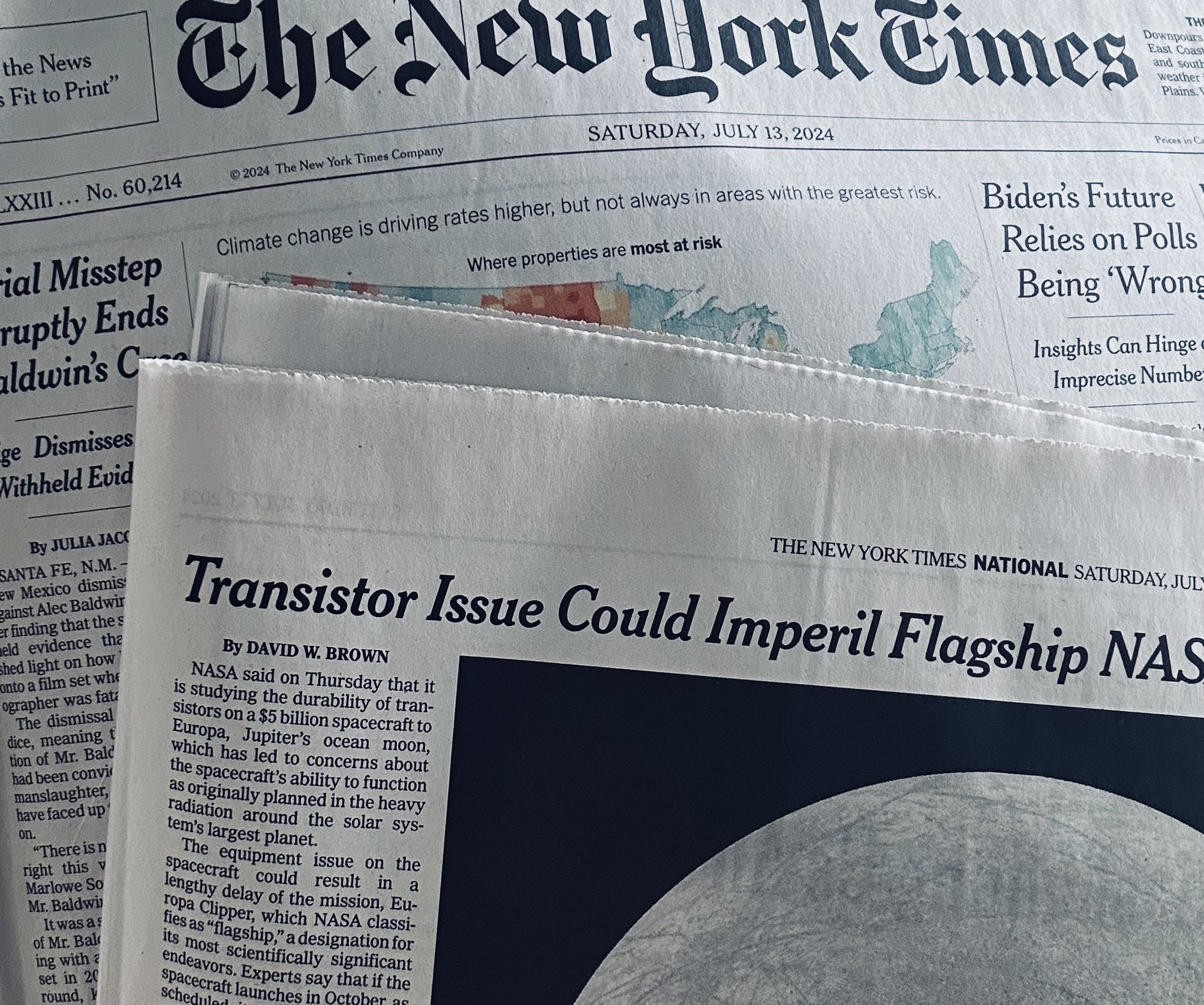
For The New York Times, I tell the inside story of the desperate race to save NASA’s flagship mission to Jupiter’s ocean moon. A snippet:

People at NASA headquarters take deep breaths when the words “First Story” appear in their email. Late this spring, Curt Niebur, the lead scientist for flight programs, received such a message.

“You open that email right away,” Dr. Niebur said. “You read it, and then you reply, ‘Thank you for sharing,’ and then you bury your face in a pillow and you howl in terror.”

The matter prompting Dr. Niebur’s apprehension involved Europa Clipper, one of NASA’s most scientifically important missions. The agency’s science division created the “First Story” process to encourage science project staff members to communicate potentially bad news without fear of overreaction by leadership.

This news seemed exceptionally bad. If what Dr. Niebur was reading was true, Europa Clipper was cooked.

NASA had spent more than $5 billion on the planetary probe. It is the largest ever built — as big as a basketball court with its solar arrays extended. The mission’s job is to help scientists on Earth determine the potential habitability of Europa, the moon of Jupiter that is wrapped in a thick shell of ice, beneath which a warm ocean flows with twice as much saltwater as on Earth. Scientists believe it has all the chemical ingredients for alien life to have emerged.

In late May, Europa Clipper was set to be shipped to Florida to prepare for its October flight opportunity. If it missed its launch window, scientists would face a long wait for another shot — if the problem could even be solved.

Across NASA and its affiliate research labs, teams would soon find their summer dominated by a terrifying question: Was Europa Clipper doomed?

Read the rest here. (It will be on newsstands next Tuesday.)

Update: It is today’s “Great Read” —what an honor!

A New Era of Moon Exploration

In my latest essay for The New Yorker, I explore why the moon is so busy these days, and what that means for life on Earth.

On February 22nd, a robotic lander named Odysseus touched down on the sun-washed highlands near the south pole of the moon. It was the first time since the Apollo 17 mission, fifty-two years ago, that an American spacecraft had landed gracefully on the lunar surface. And yet NASA hadn’t designed or built Odysseus; it was renting space onboard. Intuitive Machines, a relatively small aerospace firm based in Houston, was responsible for the lander, which launched atop a SpaceX rocket. The event was historic not just because it signalled a return to the moon but because it was the first time that a private company from any country had landed a spacecraft there. It won’t be the last: Odysseus marks the beginning of a new, relentless, and open-ended campaign of robotic and crewed lunar exploration. The program is called Artemis.

Read the rest here.

Earth's First Cookbook

My latest for the New Yorker was seven years in the making. I first covered the OSIRIS-REx mission when it launched in 2016, for the Week. The following year, I embedded with the team for the Earth gravity assist, and wrote about it for the Atlantic. In 2018, I was also with the team for the spacecraft’s arrival at the asteroid Bennu, which I covered for Scientific American. And now, for the New Yorker, the return of the sample to the Utah desert, and the opening of the capsule in Houston, Texas. It begins:

On a brisk day in February, 2004, Dante Lauretta, an assistant professor of planetary science at the University of Arizona, got a call from Michael Drake, the head of the school’s Lunar and Planetary Laboratory. “I have Lockheed Martin in my office,” Drake said. “They want to fly a spacecraft to an asteroid and bring back a sample. Are you in?”

Read the rest here.

What the Webb Will Show Us Next

For The New Yorker, I interviewed the astrophysicist Dr. Jane Rigby, senior project scientist of the James Webb Space Telescope. Here is a snippet:

What gaps in science do the J.W.S.T.’s unique capabilities fill?

J.W.S.T. works in the infrared. It was designed to see the light from the universe that is totally invisible to Hubble, which sees primarily in the optical and ultraviolet. About the “bluest” light that J.W.S.T. can see is the shade of red wine, and then it goes redder from there.

Because of the big bang, space is expanding—not just stuff in space but the fabric of space itself. And the light that we see from distant objects has actually been stretched by the expansion of the universe as well. That causes light from those distant objects to get stretched to longer wavelengths. It gets shifted to the red, to lower energies.

It’s just really cool that we can see almost to the end of the universe, right? We can do that because that light only travels so fast: the speed of light. We are studying galaxies whose light has been travelling for more than thirteen billion years. The universe is only about 13.8 billion years old! Those are the baby pictures of literally everything, and, in particular, of the baby galaxies that would have turned into mature galaxies like our Milky Way.

You can read the rest here.

Department of Survival

Image credit: The New Yorker

In a special digital issue of The New Yorker for the week of April 24, I have a story about NASA’s failure on the methane emission detection issue, and how NGOs have taken it on themselves to pick up the slack. A snippet:

When his phone rang, Berrien Moore III, the dean of the College of Atmospheric and Geographic Sciences at the University of Oklahoma, was fumbling with his bow tie, preparing for a formal ceremony honoring a colleague. He glanced down at the number and recognized it as NASA headquarters. This was a bad sign, he thought. In Moore’s experience, bureaucrats never called after hours with good news.

Read the rest here.

The New Yorker

This story for The New Yorker was almost a year in the making. In it, I offer an insider account of of the fabled mission development teams at NASA Jet Propulsion Laboratory, Team X and the A-Team, and tell the story of the 2019 Planetary Science Summer Seminar, the NASA “bootcamp” for planetary scientists who wish to learn how to plan missions to other worlds. A snippet:

Capture.JPG

… Two years later, at the Jet Propulsion Laboratory, in Pasadena, California, an astronautical engineer named Randii Wessen stood before a wall-sized whiteboard in a room called Left Field. Facing him were eighteen researchers—planetary scientists, astrophysicists, engineers—most in their mid-twenties, all graduate students or postdocs. Bald, bearded, and trim at sixty-one, Wessen worked on the Voyager and Cassini space probes. He is now the lead study architect of J.P.L.’s so-called A-Team—a group in charge of early space-mission concept planning at the lab’s Innovation Foundry. (The team is named both for the discipline of mission architecture and for the nineteen-eighties TV show about a crack team of do-gooding mercenaries.) No two of the hundreds of thousands of identified objects in the solar system are exactly alike; each must be explored according to its own characteristics. Successful missions, therefore, emerge from the spot where the proved and the fantastic intersect. The best way to explore Io, Jupiter’s volcanic moon, could be an orbiter, but it could also be a lava boat. Often, these so-crazy-they-might-work solutions begin on Wessen’s whiteboards.

Read the rest here.

Moons of Earth and Saturn

The New York Times has kept me busy of late. In the special section commemorating the fiftieth anniversary of the Apollo 11 moon landing, I had two pieces: one on the future of the American astronaut corps, and another on the haunting restoration of the Apollo Mission Control at NASA Johnson Space Center. Another piece I am particularly proud of is the announcement of a mission to Titan, the mysterious moon of Saturn, and the only place in our solar system other than Earth with standing liquid seas.

Image credit: The New York Times

Image credit: The New York Times

NASA Announces New Dragonfly Drone Mission to Explore Titan
(The New York Times)

Because of the nature of its atmosphere, Titan is a very Earthlike place. Chemically, it is much like our world’s primordial past. The surface pressure of Titan is one-and-a-half times the surface pressure of Earth, and the same sorts of interactions between air, land and sea take place. Titan thus has familiar geology. Methane on Titan plays the role that water plays here. Its methane cycle is analogous to Earth’s water cycle. It has methane clouds, methane rain and methane lakes and seas on the surface.

“There’s going to be a tremendous change in the fabric of how we see Titan as a world,” said Dr. Ralph Lorenz of Applied Physics Laboratory, the Dragonfly project scientist in an April interview. He predicted that features of Titan will be, “recognizable, but different in flavor from what you see on Earth and Mars.”

That might include the things that wiggle. Complex organic molecules fall from its atmosphere onto the surface of Titan, gather over long periods of time and can be processed further. If cryovolcanoes erupt on Titan’s surface, as data from the Cassini spacecraft suggests, the organic material can mix with liquid water. Sunlight, at the same time, drives the moon’s photochemistry, introducing energy to a system primed for life.

NASA Reopens Apollo Mission Control Room That Once Landed Men on Moon
(The New York Times)

Apollo mission control had been abandoned in 1992, with all operations moved to a modernized mission control center elsewhere in the building. Center employees, friends, family — and anyone, really, who had access to Building 30 — could walk in, take a seat, take a lunch break and take pictures.

While they were there, they might take a button from one of the computer consoles. Or a switch or a dial, anything small — a personal memento from an ancient American achievement. The furniture fabric and carpet underfoot grew threadbare. The room was dark; none of the equipment had power. Wires hung where rotary phones had once sat. The giant overhead screens in front of the room were damaged, and the room smelled of mildew. Yellow duct tape held carpet together in places.

“You knew it wasn’t right — you just knew,” said Sandra Tetley, the historic preservation officer at the Johnson Space Center. “But it was not a priority. We are an organization that’s moving toward the future, so there is not a budget to do things like this.”

The project began in earnest six years ago. The anniversary loomed, and that was the catalyst to fix up mission control, and to do it right. “We wanted to meet a high standard to restore it, and we were able to meet this 50th anniversary,” Ms. Tetley said.

As New Space Race Beckons, Astronauts Face Identity Crisis
(The New York Times)

Christopher Ferguson trains from 8 a.m. to 8 p.m. at NASA’s Johnson Space Center in Houston. A recent day for him was typical: five hours in a launch simulation with the mission operations team. He trained alongside Sunita Williams, herself a two-time space flier and veteran of the space station.

Halfway through the session, the two swapped roles, preparing for situations that might arise on an actual mission. The balance of the day was spent planning timeline management when inserting a crew into a rocket, so that when the hatch closes, all the right things are on the inside, and all the right things are on the outside.

The difference between Mr. Ferguson and Ms. Williams is that Mr. Ferguson does not work for NASA. He works for Boeing and will fly on the first crewed mission of Starliner. Boeing and SpaceX are part of Commercial Crew, a NASA-supported program that has tasked American companies with building spacecraft capable of carrying astronauts to the space station. NASA has relied on Russia’s space program for launching astronauts since the last shuttle returned to Earth in 2011.

A Roundup of Recent Work

It’s been a busy few weeks. Here are a few recent pieces I have had written, and snippets of each.

Neptune’s Moon Triton Is Destination of Proposed NASA Mission
(The New York Times)

Visits to the outer solar system are usually conducted as NASA flagship missions that cost billions of dollars, like the recently concluded Cassini mission to Saturn or the Europa Clipper spacecraft set for launch in the 2020s.

While these projects have produced significant achievements, smaller, less pricey missions also might advance planetary science. On Mars, for instance, no single spacecraft did everything, but in aggregate and over time, the robots sent there revealed the planet’s watery past and set the stage for future astronauts.

That’s why the scientists behind Trident proposal, which will be formally presented to NASA later this month, are seeking support under the agency’s highly competitive Discovery program, for missions that are supposed to cost less than $500 million.

Europa Mission Gets New Instrument to Look for Signs of Habitability
(Scientific American)

NASA is changing one of the key scientific instruments on Europa Clipper, its next major mission to the outer planets of the solar system, and has brought in a scientific luminary to lead it, project leaders announced today. Clipper is set to orbit Jupiter and study Europa, the icy Jovian moon, across multiple flybys. Earlier this month, NASA headquarters terminated the mission’s ICEMAG magnetometer instrument, citing overruns in its estimated budget. The move left the spacecraft without an essential tool to study Europa’s interior ocean, where astrobiologists hope extraterrestrial organisms might be found.

Margaret Kivelson, a professor emerita at the University of California, Los Angeles, will lead the effort to develop a simplified magnetometer to replace ICEMAG. The instrument will measure Europa’s magnetic field and gather data on the ocean’s depth and salinity. Kivelson previously led the magnetometer team on the spacecraft Galileo, which orbited Jupiter in the 1990s. She is credited with discovering the ocean beneath Europa’s ice shell.

How NASA’s Opportunity Rover Made Mars Part of Earth
(Smithsonian)

MER came in the aftermath of failed mission proposals by Ray Arvidson, a professor at Washington University in St. Louis; Larry Soderblom of the U.S. Geological Survey; and Steve Squyres, a professor at Cornell University. Each of the three had been beaten by David Paige of University of California, Los Angeles, whose ill-fated Mars Polar Lander was selected for flight by NASA.

“During an [American Geophysical Union] meeting, I stopped Steve in the hall,” says Arvidson. “I said, ‘I’m a pretty sore loser. How about you?’ And that was the start.” Arvidson, Squyres and Soderblom merged their various teams and set about writing a joint proposal to get a rover on the Martian surface.

NASA Considers a Rover Mission to Go Cave Diving on the Moon
(Smithsonian)

Once it reaches the bottom of the pit, Kerber says, Axel would explore the cavern floor, providing humanity’s first close look at the subterranean realms of the moon. The rover would carry six times as much tether as it needs, so however far the bottom of the cavern is, Axel should be able to descend deeply enough to discover what waits below.

“The bottom of the pit is total exploration. We have enough time to just see what the heck is down there. We are thinking a monolith,” Kerber jokes, “or a big door covered in hieroglyphics.”

Pluto as Planetary Coming of Age

This composite of enhanced color images of Pluto (lower right) and Charon (upper left), taken by NASA's New Horizons spacecraft on July 14, 2015, highlights the wide range of surface features on the small worlds. Working with the New Horizons missio…

This composite of enhanced color images of Pluto (lower right) and Charon (upper left), taken by NASA's New Horizons spacecraft on July 14, 2015, highlights the wide range of surface features on the small worlds. Working with the New Horizons mission team, the International Astronomical Union (IAU) has approved the themes to be used for naming the surface features on Pluto and its moons. (Credit: NASA/JHUAPL/SwRI)

Kirby Runyon cuts the figure of an astronaut, and you just know that he would be helpful in a bar fight, but you also get the impression that he would defuse things for you before it got that far. He is a young man and a newly-minted Ph.D., and with an abstract submitted to the Lunar and Planetary Science Conference late last March, stepped into a white-hot spotlight with an international audience. He and one of his co-authors, Alan Stern, the principal investigator on the New Horizons mission to Pluto, have taken a swing at the question of planethood.

Runyon’s definition of a planet is a single sentence in length: “A planet is a sub-stellar mass body that has never undergone nuclear fusion and that has enough gravitation to be round due to hydrostatic equilibrium regardless of its orbital parameters.” In other words, a planet is a ball in space that’s not a star. That means, yes, Pluto is a planet. It also means that the Moon is a planet. Europa is a planet. Ganymede is a planet.

In comparison, the newly-established definition of a planet by the International Astronomical Union states: “A planet is a celestial body that is in orbit around the Sun, has sufficient mass for its self-gravity to overcome rigid body forces so that it assumes a hydrostatic equilibrium (nearly round) shape, and has cleared the neighborhood around its orbit.” In this regime, were Ganymede knocked from orbit around Jupiter and into orbit around the Sun, it would still be Ganymede, but might suddenly, according to the IAU, be a planet. At an instinctive level, this feels wrong, like saying that if a dog climbed onto a bookshelf, it would then be a cat. The astronomy view categorizes a planet based on what it orbits. Runyon’s assertion is that a planet should be defined by what it is.

What imbues Runyon’s definition with resilience is that it doesn’t seek to somehow overturn that of the IAU, and he has no intention of submitting it to the IAU for consideration. “If certain types of astronomers want to have an orbital dynamic definition of a planet,” he says, “and that’s useful to them, fine. But most scientist who study planets are more aligned now with the geosciences than they are with astronomical scientists. And that definition of ‘planet’ just isn’t useful to us. It doesn’t help us communicate our ideas.” Informally, planetary scientists have always called all sorts of bodies in space “planets.” But formally, too, in peer-reviewed literature, technical moons are called planets. Runyon lists scores of such references made both before and after the IAU redefinition.

This is in part about the coming of age of planetary science. It is a young field, a single generation old, the plucky upstart once the exclusive domain of physics, then of astronomy, but whose constituent sciences now include geology, chemistry, and biology. Mars was once something you look up at, a dot in the sky. Celestial. Now it’s something you look down on from orbit, or across from the surface. It’s terrestrial. Geophysical.

“Carl Sagan said, ‘In science there are no authorities; at most, there are experts,’” Runyon tells me as we talk outside the convention center where he presented abstract. This isn’t a heated argument, and he counts Mike Brown, the famed “Pluto Killer,” as a friendly correspondent. Let the astronomers do what they want, he explains brightly, but leave us—i.e., geologists—out of it. The concept isn’t even unique. “To astronomers studying the composition of stars and nebulae, especially stars, they call anything heavier than element number two―anything heavier than helium―a metal. That’s just a convenient word for them. No one’s fighting about this,” says Runyon. “They know what they mean when they say metal, and it’s different from the common definition. You take the spectra of stars, and you see there’s oxygen and nitrogen and argon in stars’ atmospheres, you call that a high metallicity star. And that’s fine. Metallurgists aren’t fighting them over the word metal.”

Kirby Runyon presents his research on Martian sand sheets. (Credit: Lunar and Planetary Institute)

Kirby Runyon presents his research on Martian sand sheets. (Credit: Lunar and Planetary Institute)

This matters beyond the arcane world of scientific abstracts and poster sessions. Very rarely does a scientific debate spill into the public sphere and draw not only keen interest, but steely opinions. Evolution, certainly. The age of the Earth in some religious circles. But you don’t often see finger-pointed assertions over scientific nomenclature. The Washington Post doesn’t give a thousand words to disagreements over the precise definition of “suevites” (a type of rock formed during impact events) though scientists do debate its usage. This matter of Pluto, however, is both consequential and easily understood. Everyone has their own take on whether it is a planet.

Under Runyon’s definition, there are at least 110 planets in the solar system. This seems at once absurd, but resolves into something very interesting. He explains that the idea of planets being something you must memorize is a pointless exercise. Memorizing the periodic table of elements doesn’t make one a chemist. But just as the table itself is elegant and informative, plot all the planets on a table and you get something equally elegant. Terrestrial planets, gas giant planets, ice giant planets, dwarf planets, exoplanets, each arranged and subgrouped with common characteristics. Europa so plotted might be categorized as an icy dwarf satellite planet.

And suddenly, rather than rote memorization, Mercury, Venus, Earth, and so on, you have an ambitious and quite possibly tectonic effect on education. Rather than eliminating things to learn―Pluto itself has been rendered ontologically unsound since the IAU announcement, disappearing not only from textbooks but also consumer goods and media―you have the introduction of worlds that rarely appear in the classroom, Makemake, Mimas, Miranda and more. The conversation about Pluto has arguably been a net positive for the public, whose idea of the solar system is too often limited to plastic beads on wires circling a light bulb.

An invested public with a robust science education is as important as ever before. Even with our pedestrian terrestrial political problems, it’s a good time to be a human being. We stand on a precipice of sorts, in which asteroids, planets―even stars―are accessible not only by scientists with instrument-laden spacecraft, but soon by the working man and woman. One easily imagines a real future in the lifetimes of our children in which “planet” relates not to hydrostatic equilibria or accretion disc formation, but by something inherently more utilitarian. Planet will be a shorthand for something vaguely accessible by humans and our tools for long durations. Somewhere useful. Somewhere with a horizon commensurate to that which the human mind has evolved to expect. Can I drive a shovel into the body and pull up raw materials? In plain science fiction terms, can I land my spaceship on it? Is it round and can I fly my gas mining barge through it?

In both the very short term and very long, what is or isn’t a planet is not particularly important. In the middle, however, in our present-day future in which dot-com billionaires want to put people in space, and not in capsules of three, but transports of hundreds, and they say this with authority and are investing the capital to make it a reality, suddenly “planet” is a word due to be handed back to the people. Given a better spacesuit, if I lived on Titan or Mars, is there a measurable difference in bodies? This land is your land.